
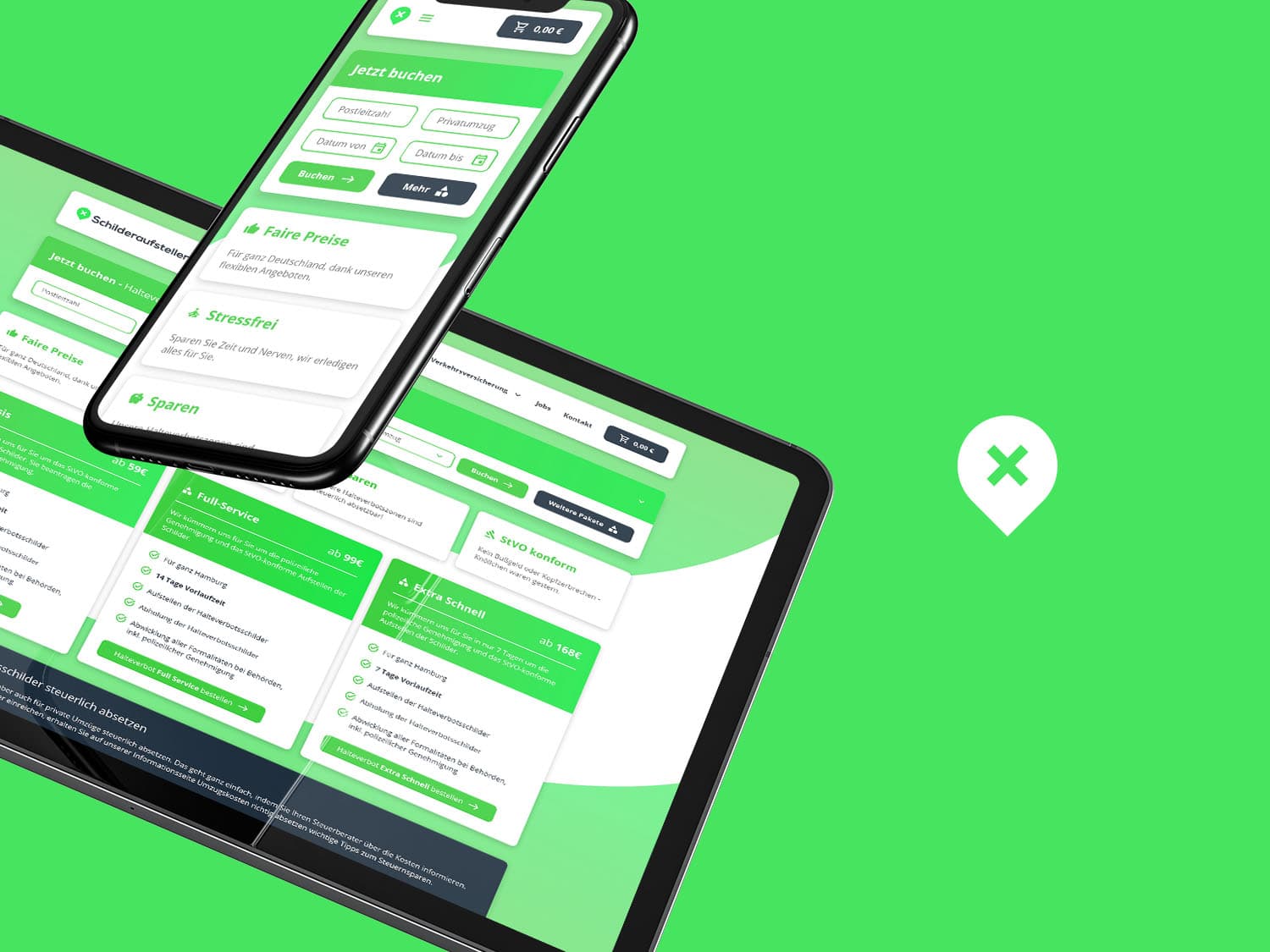

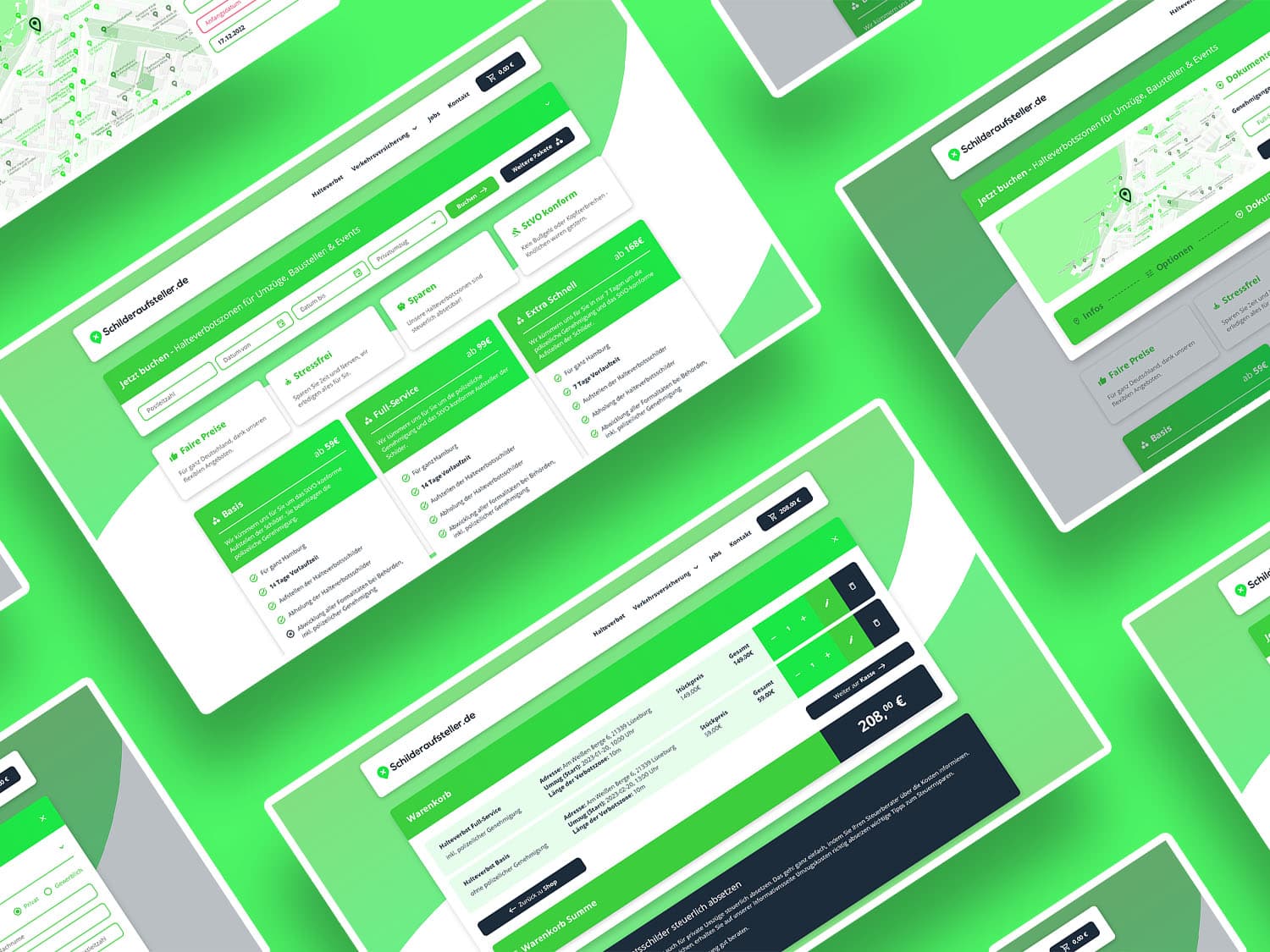

By optimizing the user flow, users are guided step by step through the ordering process and reach their goal without detours. A clear, modern interface leads through the entire, otherwise rather bureaucratic process. We worked out the concept, interface design and development in cooperation with the customer.
Making the entry into the ordering process as easy as possible was the focus of this project. Presenting the various options clearly was just as important.
A digital service for handling temporary no-parking zones: web shop, driver app and backend with automated invoicing, in production since 2024.
Ordering a temporary no-parking zone is a procedure bound to official requirements. People ordering have to supply details they do not usually have at hand: the exact location of the area, the period, the length of the zone, the occasion. Each of these details affects price, permission and execution.
That makes the task different from an ordinary shopping cart. What is ordered is not goods but a service with a date, a place and conditions attached. The price follows from a combination of entries rather than from an article number. And a mistake in those entries does not surface at checkout, it surfaces on the day the signs go up.
The range of people ordering adds to this. Moves, trades, construction sites and events bring very different levels of prior knowledge. A process that assumes familiarity with the terminology loses exactly the group ordering for the first time. Making the entry into the process as easy as possible and presenting the various options clearly was therefore the focus.
By optimizing the user flow, users are guided step by step through the ordering process and reach their goal without detours. In practical terms that means breaking the order into sections, each asking one question and opening the next only afterwards. Entries that depend on each other appear in the order in which they condition one another.
A clear, modern interface leads through the entire, otherwise rather bureaucratic process. This mainly concerns how the options are presented. Where several variants are available, the difference has to be visible at the moment of choice rather than hidden in a footnote.
Concept, interface design and development were worked out in cooperation with the customer. For processes with an operational background that is the more durable order of work, because special cases from daily business feed into the structure before any screens exist. The shop process has since grown into a platform of web shop, backend and driver app for the daily routes, with photo documentation and automated invoicing.
As soon as an order involves work carried out on site, the task does not end at checkout. Order, scheduling and execution have to describe the same record. If the period of a zone changes, that change has to reach route planning, otherwise two versions of the truth exist side by side.
Photo documentation is more than a record in this chain. It evidences the condition and the time at which the signs were placed and becomes the reference everyone involved returns to later. To serve that purpose it has to be tied unambiguously to one job and must not be filed separately from the case.
Automated invoicing builds on top of that. It is only as reliable as the data coming back from ordering and execution. The important decision therefore falls early, with the data model: which details belong to the job, which to the individual zone, which to the route. Kept apart properly, procedures can be extended later without touching the foundation.
Write to us or book an initial consultation directly. We reply within 24 hours, usually faster on weekdays.